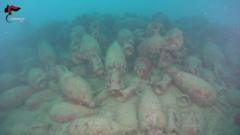
You think history is fully written. Then a fisherman spots what looks like an odd rock on a sonar screen three miles off the coast of Sicily, and everything changes.
Italian divers recently located a remarkably intact 2,100-year-old Roman cargo vessel resting 46 meters down on the seabed near Mazara del Vallo. Piled high with hundreds of pristine ceramic storage jars known as amphorae, this site provides a rare window into the frantic maritime trade routes of the late Roman Republic. Italy's Culture Minister, Alessandro Giuli, wasted no time calling it one of the most important underwater archaeological finds of recent years.
Let's look at what actually happened, why this discovery matters, and what experts are eyeing next.
Stumbling Upon History
The discovery wasn't made by a high-funded academic expedition using multi-million-dollar sonar arrays. It started with local underwater fishermen, Giacomo De Mola and Igor Bisulli, tracking shapes on a standard marine scanner.
De Mola thought he was looking at a regular boulder. He dove down to check it out anyway.
"Visibility wasn't the best... I got closer. And my heart stopped. Below me was a vast expanse of amphorae," De Mola shared in a viral social media post featuring raw footage of the wreck.
Being a responsible citizen, he immediately alerted the Soprintendenza del Mare of the Sicilian Region. Soon after, specialized units from the Carabinieri Command for the Protection of Cultural Heritage—specifically working alongside Palermo and Messina marine squads—secured the perimeter.
Decoding the Cargo
The ship measures roughly 21 meters long and six meters wide. That is a decent-sized merchant freighter for the era. But the real story lies in its cargo.
Archaeologists identified hundreds of amphorae scattered across the site, largely belonging to the Dressel 1A classification. If you study ancient trade, you know Dressel 1 containers are massive markers of late Republican economic expansion. They were heavy, cylindrical ceramic beasts primarily manufactured along Italy's Tyrrhenian coast—stretching between Etruria and Campania.
What were they hauling? Mostly wine. Roman elites couldn't get enough of it, and provinces across the Mediterranean relied heavily on Italian exports.
Aside from the massive ceramic haul, investigators documented two lead anchor stocks and another mysterious lead structure on the seabed. These heavy metal components offer clues about how the ship was rigged, how it dropped anchor in an emergency, and what caused it to plunge into the dark depths over two millennia ago.
Why This Shipwreck Matters Right Now
Most people assume we have mapped out every square inch of the Mediterranean. We haven't. The sea floor is an enormous museum keeping secrets under crushing pressure and thick layers of sediment.
Finds like the Mazara del Vallo wreck matter for three distinct reasons:
- Economic Footprints: They map out exact shipping lanes used during periods of aggressive Roman expansion.
- Manufacturing Insights: The concentration of Dressel 1A jars helps historians date production shifts and ceramic packaging standards.
- Preservation Realities: At 46 meters deep, the wreck sits just past recreational limits for casual divers, protecting it from widespread looting while remaining accessible to state-authorized underwater archaeologists.
Working at that depth isn't easy. Current plans from the Sicilian authorities involve detailed digital mapping, structural analysis of the hull remnants hidden beneath the amphorae, and deciding whether any artifacts need extraction for conservation.
You won't see this ship towed up to a museum dock tomorrow. Sites like this are fragile. Exposing waterlogged wood and ancient ceramics to modern air requires careful, slow-moving science. For now, the ship remains where it sank, guarded by the Italian police and watched over by the Mediterranean currents.
Keep an eye on updates from the Soprintendenza del Mare as they map the rest of the hull. Every single jar pulled from that site tells a story about the people who built Rome's vast commercial empire.