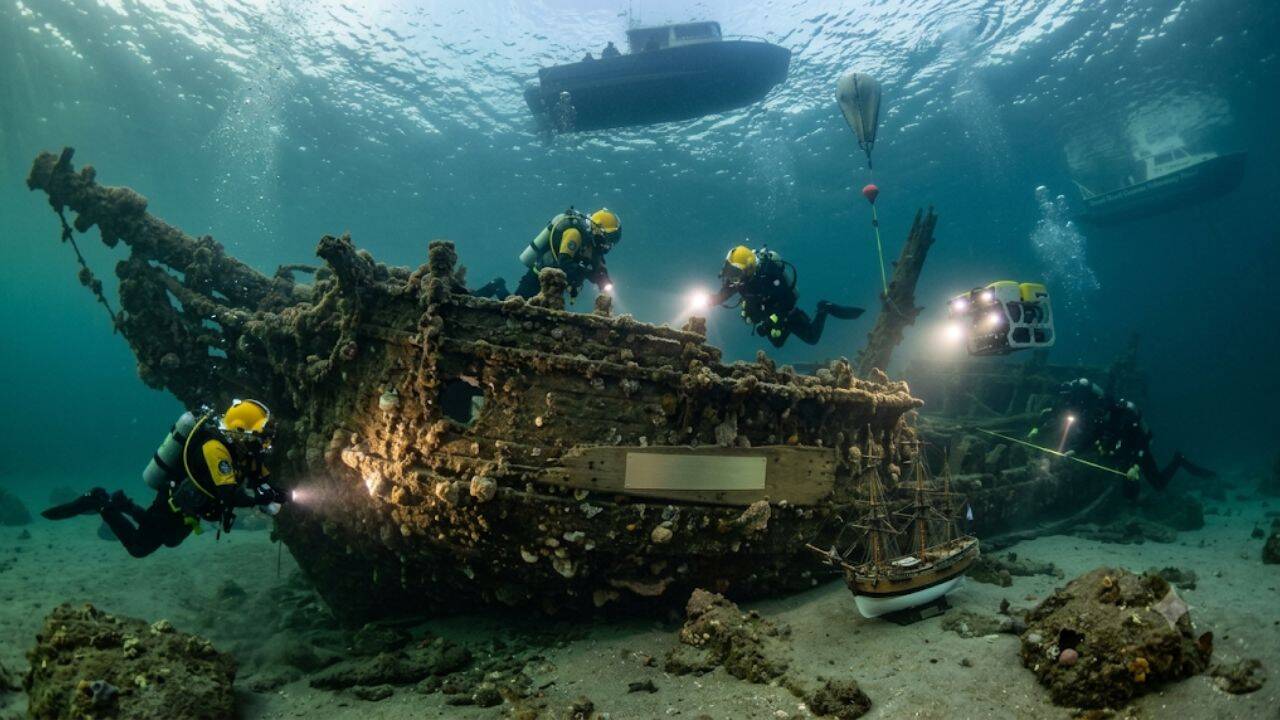
You don't expect to find the most important ship in Pacific history sitting in a muddy harbor in Rhode Island. It sounds like a bad joke. The vessel that carried Captain James Cook across the globe, mapped New Zealand, and charted the eastern coast of Australia shouldn't be rotting just north of Goat Island. But it is.
After a grinding twenty-six-year search, maritime archaeologists have officially confirmed that a wreck known as site RI 2394 is indeed the remains of HM Bark Endeavour.
The announcement settled one of the longest-running arguments in modern maritime archaeology. It also opened a messy conversation about colonial history, ownership, and what we actually owe to the past. This wasn't a sudden, cinematic moment where a diver wiped mud off a brass bell with the ship's name on it. It was a slow, painstaking accumulation of tiny details. Wood grains, unusual joints, and old cargo receipts eventually formed an undeniable picture.
People want clear answers from history. They want a smoking gun. In deep-sea archaeology, you rarely get one. Instead, the team from the Australian National Maritime Museum relied on what they call a preponderance of evidence. They lined up the physical reality of the timber left in the silt against centuries-old British Royal Navy records. The pieces fit perfectly.
Understanding why this wreck matters requires looking past the romantic myth of exploration. The ship itself had a brutal, working-class life long before and long after Cook ever stepped onto its deck.
From Coal Carrier to Sovereign Tool
The ship didn't start its life with an aristocratic pedigree. It was built in Whitby, England, in 1764 as a plain, flat-bottomed coal hauler named the Earl of Pembroke. It was broad, slow, and ugly. The Royal Navy bought it in 1768 because those exact traits made it perfect for a long, grueling scientific expedition. It could carry tons of supplies, sail through shallow coastal waters without grounding out, and sit flat on the sand if the tide ran dry.
The navy renamed it Endeavour. They stuffed it with astronomers, botanists, and sailors, then sent James Cook into the Pacific.
Between 1768 and 1771, this wooden coal box changed the political map of the world. For Western nations, the voyage represents a massive leap in geographic knowledge. For the indigenous populations of the Pacific, it marks the exact moment their worlds were disrupted by European imperialism. Daryl Karp, the chief executive of the Australian National Maritime Museum, noted that the ship represents both scientific wonder and the dark reality of colonization.
When Cook returned to England, the navy had no sentimental use for the vessel. They turned it into a mundane cargo transport, sailing back and forth to the Falkland Islands. Eventually, they sold it to a private merchant who renamed it Lord Sandwich.
That is how the ship wound up on the wrong side of the world.
During the American War of Independence, the British government hired the Lord Sandwich to ferry troops across the Atlantic. By 1778, the ship was a battered, leaking mess. The British stripped it of its dignity and turned it into a crowded prison ship, anchoring it in Newport Harbor to hold captured American forces.
Its end came quickly. A French fleet sailed toward Newport to support the American rebels. Desperate to block the harbor entrance and protect their garrison, British commanders ordered thirteen transport ships to be deliberately scuttled. Workers hacked holes in the hull of the Lord Sandwich. It sank into the cold Rhode Island mud, where it stayed for over two centuries.
Cracking a Twenty Six Year Cold Case
Finding the needle in that particular haystack took decades. The hunt didn't even start in the water. It began in dusty archives in 1998, when two Australian historians named Mike Connell and Des Liddy began tracking the paperwork of the long-lost fleet. They proved through historical logistics that the old Endeavour was definitely among the ships sunk in Newport Harbor during the 1778 blockade.
The next year, the Australian National Maritime Museum teamed up with the Rhode Island Marine Archaeology Project, known as RIMAP.
The water in Newport Harbor is terrible for archaeology. It is dark, filled with silt, and constantly churned up by boat traffic. Divers spent years feeling their way through the muck, mapping out multiple 18th-century wreck sites. Early surveys between 1999 and 2004 yielded nothing concrete. They found old ballast stones, fragments of rotting timber, and chunks of coal, but nothing that definitively separated one generic British transport from another.
The real breakthrough happened in 2016. Archival research by Dr. Nigel Erskine managed to isolate a tiny pocket of the harbor just north of Goat Island. His work proved that only five of the thirteen scuttled ships went down in that specific zone. One of those five had to be the Lord Sandwich.
Archaeologists spent the next four years investigating those five specific targets. They focused heavily on site RI 2394.
The Boring Details That Solved the Mystery
Forget about gold coins or hidden chests. The evidence that identified the Endeavour came down to the exact millimeter of wood thickness.
Dr. James Hunter and his team of maritime archaeologists began comparing the physical measurements of RI 2394 with the surviving 1768 Royal Navy survey plans of the Endeavour. The dimensions were identical. The scantlings—the technical term for the thickness and size of a ship's structural timbers—matched the historic blueprints down to the smallest fractions.
The team looked at the wood itself. They took tiny core samples from the surviving hull frames. Laboratory testing showed that almost all the timbers were hewn from European white oak. The keel, however, was made of elm. This perfectly matched the regional shipbuilding style of Whitby where the Earl of Pembroke was constructed.
Then they found the repairs.
Records showed the Endeavour underwent specific hull maintenance in 1776 after its rough years at sea. The archaeologists uncovered those exact structural modifications on the forward section of the keel on the RI 2394 site.
The definitive clue was a highly unusual engineering feature in the bow. Because the ship was originally built to haul massive loads of coal, the builders used a rare, specific joint called a scarph joint to link the stempost to the keel. It gave the flat-bottomed vessel extra strength. When the dive team cleared away the silt from the bow area of RI 2394, they found that exact scarph joint.
Combine that with a massive linear stone ballast pile, four iron cannons, and the exact placement of the bilge pump wells, and the math becomes simple. No other ship in that harbor matched those criteria.
Why the Discovery Sparked an International Feud
The identification should have been a moment of shared triumph. Instead, it triggered a massive bureaucratic argument.
In 2022, the Australian National Maritime Museum got tired of waiting and unilaterally declared that the mystery was solved. They held a major press conference announcing they had found the Endeavour.
The reaction from Rhode Island was immediate and furious. RIMAP issued a blunt statement calling the Australian announcement a breach of contract. They claimed the conclusion was driven by Australian national emotion and politics rather than sober scientific consensus. They argued that while RI 2394 was a strong candidate, more data was required before closing the book.
The Australians didn't back down. They spent the next three years compiling every single scrap of data into a massive final report. They used advanced computer software to stitch together thousands of underwater photographs, creating a highly detailed 3D digital model of the entire wreck site. They presented the findings at international archaeological forums. Nobody could disprove the data.
The local teams eventually acknowledged the sheer volume of the work, even if some regional preservationists still prefer to hedge their bets. The dispute reveals how much emotional weight we still attach to these old pieces of wood. To Australia, this is a foundational relic of their modern nation. To Rhode Island, it is a piece of American Revolutionary history sitting in their local waters.
The Real Enemy is the Silt
Now that we know what the wreck is, the clock is ticking louder than ever.
Leaving the ship in the water means watching it slowly vanish. The biggest threat to RI 2394 isn't human souvenir hunters or boat anchors; it is biology. Marine borers, specifically shipworms and tiny wood-boring crustaceans called gribbles, are actively eating the exposed timbers. Every year the wood spends exposed to the currents, more historic data turns to dust.
You can't just dig it up. Raising a 250-year-old waterlogged wooden ship is an engineering nightmare that costs tens of millions of dollars. The moment that wood hits the open air, the cellular structure collapses, and it rots into mush unless it undergoes decades of expensive chemical preservation.
The immediate next steps for the international preservation teams involve securing the highest level of legal protection for the site. This means establishing permanent exclusion zones to prevent anchor damage and applying specialized physical barriers over the exposed wood to suffocate the marine borers. If you want to see the ship yourself, skip the trip to Rhode Island. Your best bet is visiting the Australian National Maritime Museum website to study the open-access 3D digital site maps created by the dive teams. The physical bones of the ship will stay exactly where they sank, buried under the protective mud of Newport Harbor.