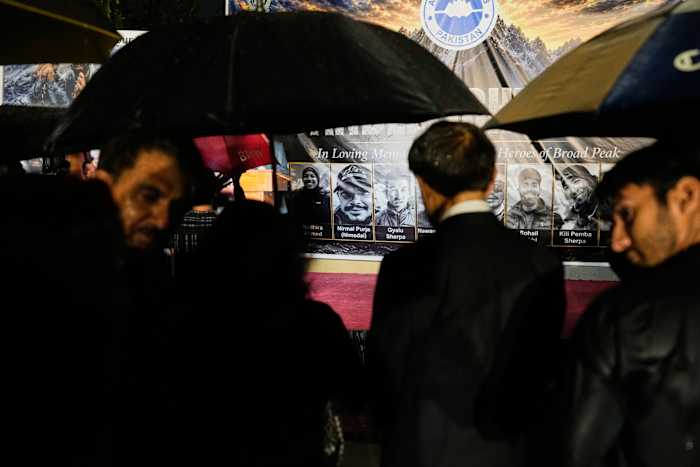
The mountains don't care about your dreams. They don't care about your preparation, your social media announcements, or your resolve. This brutal reality hit home again this week when search teams finally recovered the remains of Mallory Geis on Broad Peak in Pakistan.
Geis, a 39-year-old from San Antonio, was the final missing member of an international team wiped out by an avalanche on July 31. Ten lives were lost in an instant. It’s a staggering toll that forces us to look at why experienced and novice climbers alike continue to risk everything on these 8,000-meter giants.
The harsh reality of high altitude expeditions
When you look at the geography of the Karakoram range, you’re looking at some of the most unstable terrain on the planet. Broad Peak sits at 26,247 feet. It’s a beast. The environment there is essentially a ticking clock of shifting ice, unpredictable weather patterns, and slopes that can disintegrate without warning.
Geis was on her first attempt at an 8,000-meter peak. She had recently closed her Pilates studio to pursue this path. That’s a massive transition. People often romanticize the idea of "leaving it all behind" to find themselves in the wild. But the mountains aren't a self-help retreat. They are environments where human biology struggles to exist, let alone perform.
The avalanche that took this team didn’t care that the expedition was led by Nirmal Purja. You might know him as "Nims Dai" from the documentary 14 Peaks. Having a world-class leader doesn't make you invincible. It just means you have a better chance of navigating the known risks. It can’t account for a massive, sudden slope failure.
Why we keep climbing despite the death toll
You have to wonder why the risk-to-reward ratio remains so skewed. The answer usually isn't about logic. It’s about the pull of the summit. There’s an undeniable addiction to the extreme. Once you’ve stood at the edge of the world, it’s hard to go back to the cubicle or the studio.
But we need to stop pretending that every expedition is a calculated, manageable risk. In northern Pakistan, the dangers are visceral. Avalanches, rockfall, and altitude sickness aren't anomalies; they are part of the landscape.
If you are planning to get into high-altitude mountaineering, don't just focus on the fitness aspect. Focus on the psychology of failure. Most people prepare for the summit. Very few prepare for the moment things go wrong.
What it takes to survive the Karakoram
If you look at the survivors of high-altitude disasters, they all share a specific trait: the ability to turn back. It sounds simple. It’s the hardest thing a climber will ever do.
- Understand the weather cycles. In the Karakoram, the window of stability is tiny. If you miss it, you don't gamble. You retreat.
- Respect the avalanche risk. You can’t predict a slope collapse perfectly. You can only minimize your exposure. That means keeping movement through high-risk zones as brief as possible.
- Audit your team. Are you going with people who are obsessed with the summit at all costs? Or are you with people who prioritize safety? The culture of your team dictates your survival rate.
Mallory Geis was seeking a new chapter. The tragedy of her death, and the death of her nine teammates, is a painful reminder that the "leap into the unknown" carries a price that can't be paid back.
The recovery of her remains brings a quiet end to a search that has haunted the mountaineering community for weeks. It’s a sobering end. For those still looking to the peaks, let this be the reality check that matters. The mountain is always there, but you don't have to be.
If you find yourself standing at the base of an 8,000-meter giant, remember that the most successful climbers are the ones who make it home. Train hard. Be humble. And know when to walk away before the mountain decides for you.


