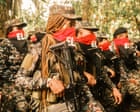
Colombia sits at the edge of a military precipice. Following the inauguration of President Abelardo de la Espriella, the nation's 62-year-old internal conflict is entering a volatile new phase. The country’s last major left-wing insurgent organization, the National Liberation Army, known locally as the ELN, is actively fortifying its jungle encampments and preparing for renewed hostilities.
If you look past the official political rhetoric, the reality on the ground in departments like Chocó and Catatumbo tells a story of imminent escalation. Peace talks have completely shattered. A hardline administration has taken power with promises of total security crackdowns, and rebel commanders are making no secret of their intent to strike back.
The Collapse of Total Peace
For the past few years, the previous leftist administration chased an ambitious doctrine of total peace. That approach involved opening simultaneous negotiations with every armed faction operating inside Colombian borders. It failed to secure lasting stability. The ELN walked away from the table after years of stalled negotiations, alternating ceasefires, and high-profile attacks on military installations.
Now, the political pendulum has swung wildly in the opposite direction. President De la Espriella took office on Friday with a straightforward ultimatum: armed groups have one month to surrender or face an uncompromising military offensive. Borrowing inspiration from security models popularized in El Salvador, the new government plans to ramp up security cooperation with the United States and construct high-security mega-prisons.
Rebel leadership hasn't blinked. Commanders operating in the dense tropical lowlands have stated clearly that they expect total war. They aren't waiting around for diplomatic breakthroughs anymore.
Inside the Jungle Encampments
Deep inside the tropical rainforests of southern Chocó, daily life for the insurgency revolves around combat readiness. Small units of fighters, often split evenly between men and women, train beneath thick forest canopies designed to evade military surveillance drones.
Unlike the FARC, which demobilized back in 2016 after a historic accord, the ELN maintains that laying down weapons is off the table until systemic economic and political inequalities are addressed. Funding for these operations doesn't come from thin air. In Chocó, the group taxes local commerce, illegal gold mining barges that dredge the San Juan River, and massive logging operations.
Control over these lucrative river corridors triggers fierce territorial disputes. The ELN frequently clashes not just with state security forces, but also with rival right-wing paramilitary networks like the Gulf Clan. These criminal syndicates view the same jungle territory as prime real estate for drug trafficking routes and illicit resource extraction. Civilians caught in the middle face constant displacement, forced recruitment fears, and escalating humanitarian crises.
What Happens Next in the Conflict
The friction points are multiplying daily. Here is what you need to understand about the immediate trajectory of the conflict:
- Urban and Rural Targeting: ELN commanders have warned that retaliation won't stay restricted to remote jungle outposts. They are preparing for nationwide actions if government offensives expand.
- The Paramilitary Factor: Right-wing groups are aggressively pushing into traditional rebel zones, creating a multi-sided war over drug routes and gold fields.
- Humanitarian Fallout: Thousands of rural residents continue to flee their homes toward cities like Cúcuta, overwhelming local aid networks and human rights offices.
Colombia's historical roots of extreme land inequality remain entirely unaddressed. Until those core issues change, military crackdowns will only fuel another cycle of bloodshed. Pay close attention to the border regions over the coming weeks. That is where the next chapter of this prolonged war will unfold.