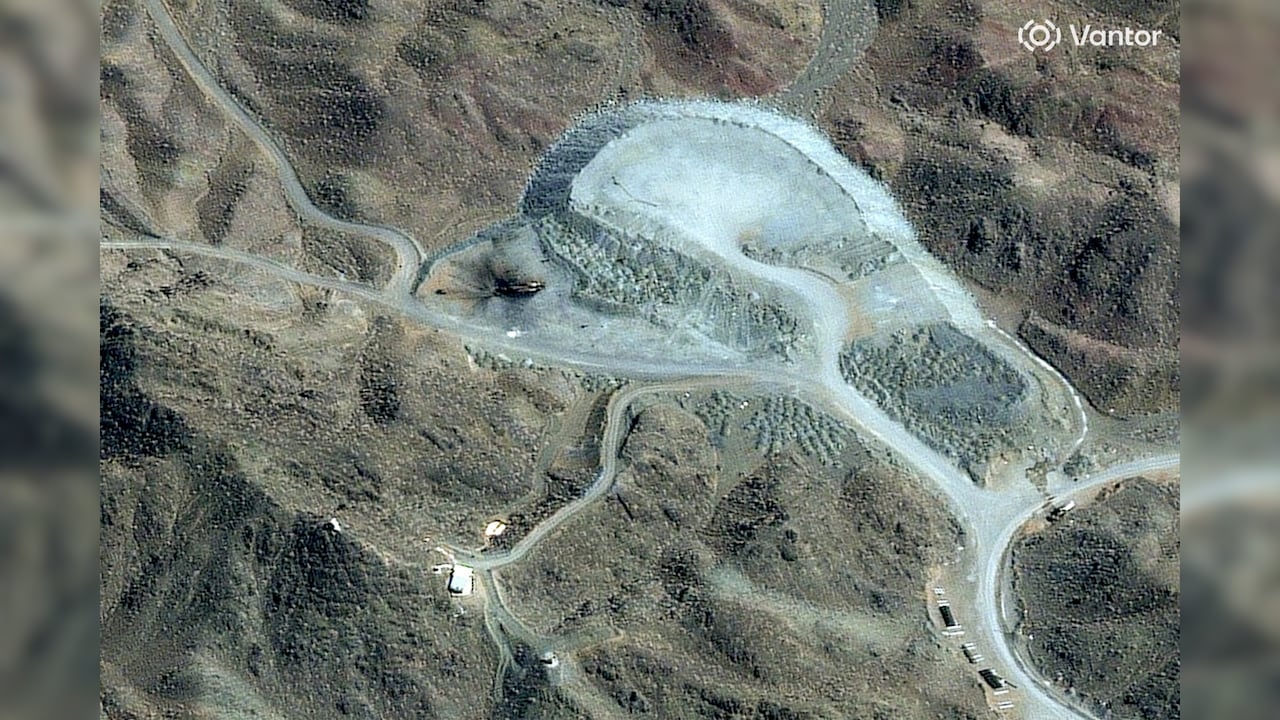
When military commentators talk about smashing Iran's nuclear facilities, they almost always point to the massive 30,000-pound GBU-57 bomb. It sounds simple enough. Fly a B-2 stealth bomber over Pickaxe Mountain, drop a few massive ordnance penetrators, and collapse the underground halls into dust.
It won't work that way.
The reality of destroying an underground nuclear fortress buried deep inside solid mountain granite is far more complicated than satellite photos and press briefings suggest. Washington politics loves a quick fix. Military hardware manufacturers love selling high-tech promises. But if you talk to actual structural engineers and intelligence analysts who study hard-target defeat, you get a completely different picture. Ground-penetrating bombs have physical limits. Iranian builders know those limits intimately.
The Physical Limits of the GBU-57 Massive Ordnance Penetrator
The military designed the GBU-57 Massive Ordnance Penetrator specifically for targets buried deep underground. It weighs 30,000 pounds, carries high-grade explosives inside an Eglin steel shell, and uses GPS guidance to hit exact coordinates. On paper, it can dig through roughly 200 feet of dirt or up to 60 feet of standard reinforced concrete.
That sounds terrifying. It is terrifying. But Pickaxe Mountain isn't a standard concrete bunker.
Iran built its newest enrichment facilities under hundreds of feet of hard limestone and granite. On top of that natural shielding, Iranian engineers spent years testing ultra-high-performance concrete. Standard commercial concrete holds up under 5,000 pounds of pressure per square inch. Iran's domestic research centers have produced reinforced concrete that withstands over 30,000 pounds per square inch.
When a kinetic penetrator hits high-strength concrete backed by solid mountain rock, the physics change dramatically.
- The bomb loses speed instantly as energy dissipates into the outer rock layers.
- The outer casing risks deforming or cracking before the fuse triggers the internal payload.
- Penetration depth drops from 200 feet down to a fraction of that depth.
Dropping two bombs on the exact same spot sounds like a clever workaround. Pilots call it sequential strike targeting. The first bomb creates a crater, and the second bomb penetrates deeper through the fresh crater. While that works in controlled testing grounds in New Mexico, real-world combat conditions rarely cooperate. Dust, displaced rock, debris, and shifting shockwaves mean the second bomb often gets deflected or detonates prematurely against displaced boulders.
Collapsing Intakes and Entrances Is Not Destruction
If you can't blow up the deep underground halls, the default alternative is sealing the entrances. Attackers hit the air filtration shafts, power lines, highway tunnels, and support infrastructure outside Pickaxe Mountain.
That strategy slows things down. It doesn't eliminate the threat.
Block the tunnels, and you trap the centrifuge cascades in a dark, isolated cave. But inside that cave, those centrifuges remain physically intact. Iran keeps backup generators, long-term ventilation systems, and emergency supplies inside the mountain complexes. Digging out a collapsed tunnel entrance takes a heavy excavation team a few weeks, maybe a couple of months at most.
A temporary delay isn't a permanent strategic solution.
Intelligence reports following previous airstrikes on nuclear sites showed a repeating pattern. Aboveground structures got completely flattened. Concrete pad buildings turned into rubble. Yet deep below, the centrifuge halls survived with minor vibration damage. Calling that an absolute victory misses the entire point of underground engineering.
What Real Hard Target Defeat Would Require
If a country truly wanted to eliminate a facility like Pickaxe Mountain without using tactical nuclear weapons, conventional airstrikes alone wouldn't cut it. You would need a much dirtier, far riskier combination of military actions.
Special Forces Sabotage on the Ground
Special operations teams would have to secure the site entrance directly. That means boots on the ground inside hostile territory. Operators would need to enter the subterranean tunnels, place shaped breaching charges directly against critical support pillars, and detonate the structural core from the inside out.
Long Term Occupation of the Surrounding Mountain
You can't just blow up a tunnel and fly home. Heavy machinery would need to stay stationed around the perimeter to prevent Iranian engineering units from clearing the rubble. That turns a swift aerial strike into an open-ended ground war in treacherous terrain.
Cyber Warfare and Supply Chain Disruption
Disrupting the delicate internal balance of uranium enrichment requires more than high explosives. Stuxnet proved that code can destroy centrifuges faster than artillery. Destroying the supply line for raw materials and Specialized carbon fiber rotatings hubs yields far longer delays than throwing heavy metal at mountain rock.
The Hard Reality of Geopolitical Escalation
Politicians like to present military choices as clean, decisive actions. "We bombed the nuclear site, problem solved." The truth is that attacking an underground nuclear fortress triggers an escalating game of cat and mouse.
Every time a military power threatens a bunker-buster attack, the targeted nation digs deeper. They pour thicker concrete. They add secondary ventilation shafts hidden miles away in regional valleys. They split enrichment work into smaller, mobile clandestine labs scattered across major cities.
By relying solely on aerial bombing campaigns to solve deep-underground nuclear threats, decision-makers create a false sense of security. You end up wasting multi-million-dollar munitions to carve crater holes into solid rock while the actual centrifuges keep spinning deep beneath your target zone.
What to Watch Next
If you want to track whether a future strike against Iran's underground nuclear sites will actually work, stop paying attention to headlines about bomb weight. Instead, watch these three specific indicators:
- Track satellite imagery for heavy excavation equipment clearing tunnel portals rather than damage to surface buildings.
- Watch for reports on ground forces or covert sabotage targeting power grids and water cooling loops away from the main site.
- Follow intelligence assessments regarding where enriched materials were moved prior to any declared strike.
Understanding underground warfare requires looking past the explosion and analyzing what happens after the smoke clears. High-explosive bombs make great footage, but solid granite and ultra-dense concrete usually win the fight.