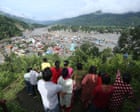
The catastrophic flash flood that recently tore through the borderlands of Nepal and Tibet isn't an isolated quirk of weather. It’s a terrifying preview of what happens when ancient ice meets modern thermal acceleration. When a massive chunk of the Langtang Lirung glacier gave way, it didn't just slide—it triggered a localized seismic impact equivalent to a magnitude 5.2 earthquake, sending a wall of water, mud, and ice careening down the Bhotekoshi River and raising downstream water levels by up to nine meters in minutes.
People want to know why high mountain terrain is failing so suddenly. The answer sits in the basic physics of the cryosphere. For decades, scientists have warned that global heating hits alpine environments harder and faster than lower-altitude regions. Yet, the sheer speed of this geological unravelling catches communities and governments off guard. For a more detailed analysis into this area, we suggest: this related article.
The Physics of Mountain Collapse
High mountains look permanent. Granite and basalt give us a psychological illusion of eternal stability. But structurally, these peaks are held together by frozen joints. Glaciers and alpine permafrost act as natural cement, binding shattered bedrock and loose moraine walls into place.
When regional temperatures spike, that cement dissolves. For further background on the matter, detailed coverage is available on BBC News.
Dr. Hamish Pritchard of the British Antarctic Survey tracked ground temperatures near the disaster zone hitting two-year highs just days before the collapse. Those extreme temperatures do three things simultaneously:
- They destabilize the snowpack.
- They pump meltwater deep into bedrock crevasses.
- They thaw the ice-rock bonds keeping steep cliffs upright.
Add unseasonal heatwaves to a saturated monsoon soil profile, and you get a recipe for disaster. The International Centre for Integrated Mountain Development notes that glacier retreat rates in the Langtang catchment have multiplied over fourfold since the mid-1960s. The ice isn't just shrinking; it's disintegrating from the inside out.
Why Downstream Populations Are Sitting Ducks
Hundreds of millions of people across Asia rely on river systems fed by Himalayan glaciers, including the Ganges and the Brahmaputra. But the immediate threat isn't water scarcity—it's the sudden, violent abundance of it.
As glaciers retreat, they leave behind unstable meltwater lakes held back by fragile debris dams known as moraines. When an avalanche or landslide hits one of these lakes, or when a cliff face collapses straight into a river channel as it did in Tibet, the resulting surge behaves like a liquid battering ram.
Borders mean nothing to flash floods. Infrastructure gets wiped out in seconds. Hydropower workers, border posts, and remote valley villages find themselves with zero reaction time. Traditional flood defenses built for historical water volume specs are useless against a multi-story wall of ice and boulders.
Where Mountain Instability Strikes Next
Geologists point out that the Himalayas aren't the only danger zone. Any high-altitude range featuring retreating glaciers and melting permafrost faces the exact same structural vulnerability.
The European Alps, the Caucasus, and the Andes share identical geological risk factors. As permafrost thaws on steep mountain faces, rockfalls and slope failures increase exponentially. It's a global phenomenon driven by industrial carbon emissions, but the local consequences fall squarely on mountain communities who contributed least to the problem.
What Needs to Happen Now
Waiting for the next disaster and running search-and-rescue operations isn't a strategy. Survival in a rapidly destabilizing mountain region requires aggressive adaptation.
First, governments must fast-track the installation of automated early warning sensors in high-risk glacial valleys. Communities downstream need precious minutes of lead time, not retroactive tragedy counts.
Second, land-use planning in alpine corridors must change. Building permanent infrastructure, roads, or hydropower stations directly in historical flood paths or beneath unstable ice masses is a gamble we can no longer afford to take.
The mountains are losing their grip. Ignoring the warning signs written across the valleys of Nepal and Tibet guarantees the next catastrophe is already locked in.