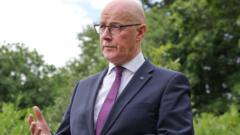
Politics makes strange bedfellows, but economic desperation makes for outright political whiplash. John Swinney has officially taken his fight to Prime Minister Andy Burnham, demanding a full reversal on a blocked Chinese-backed wind turbine project in the Highlands.
It is a high-stakes gamble. The First Minister wants Westminster to look past deep-seated security warnings to rescue a massive 1,500-job manufacturing proposal at Ardersier near Inverness. Westminster thinks he is being reckless. Downing Street is refusing to blink.
The Ardersier Battlegrounds
Let us look at what is actually on the table. Ming Yang Smart Energy, one of the planet's biggest wind turbine manufacturers, wanted to sink massive capital into the Highlands. For an area crying out for green energy manufacturing, the pitch sounded like a dream. Up to 1,500 jobs. Hundreds of millions in localized economic stimulation. A massive anchor facility for Scotland's booming offshore wind ambitions.
Then Westminster slammed the brakes on.
In March, the UK Government blocked the Ming Yang factory over national security worries. The concerns are not abstract. Under Chinese law, companies based there are tethered to the state's intelligence apparatus, obliged to cooperate with security services. Wind farms are critical national infrastructure. Letting a foreign firm with direct ties to the ruling Chinese Communist Party build the very hardware spinning across our coasts creates vulnerabilities few defense experts are willing to gamble on.
Swinney's Pushback and Westminster's Fury
Swinney isn't listening to the defense warnings, or at least, he has decided the political cost of losing those jobs outweighs the classified memos. During his first formal sit-down with Prime Minister Andy Burnham, Swinney pressed the issue directly, following up with a formal letter. He previously labeled the veto an "anti-Scottish move," pointing fingers at what he views as inconsistent energy policies.
The response from the UK Government was immediate and sharp. Energy Security Minister Michael Shanks didn't mince words on live radio, labeling Swinney's demands "irresponsible".
Here is where the narrative gets messy for the First Minister. Shanks revealed that he personally arranged a top-level security briefing for Swinney specifically to lay out the classified risks behind the Ming Yang ban. To turn around and publicly campaign for the project after sitting through that briefing is what prompted Westminster to call the move out as a purely political intervention.
You cannot claim ignorance when the intelligence agencies have laid out the data on your desk.
The Broader Dilemma Facing Scottish Green Energy
Scotland is stuck between a rock and a hard place. The nation has world-class wind resources, but the local supply chain remains stubbornly underdeveloped. Most turbine components are imported from abroad anyway. When a multi-national giant like Ming Yang comes knocking with a checkbook large enough to build a domestic plant, turning them away leaves a gaping hole in regional development plans.
Yet, ignoring intelligence warnings about foreign tech integration in critical infrastructure is how nations invite long-term sabotage. Cyber-security analysts have repeatedly flagged the risk of remote shut-off capabilities or hidden surveillance modules embedded in foreign-manufactured grid hardware.
Ming Yang hasn't given up either. Under fresh management structures, the firm has reportedly approached UK officials directly, testing whether a change in Downing Street leadership means a change in policy. But current insiders insist the ban stands. There are no active plans to resurrect the Ardersier deal.
What Happens Next
The friction between Edinburgh and London over this project exposes the raw tension between local economic survival and macro-level geopolitical defense. Swinney wants industrial growth today. Westminster wants to prevent potential cyber vulnerabilities tomorrow.
If you are tracking how regional energy projects get greenlit, watch the fallout of this clash. Expect tighter scrutiny on foreign investments, heavier vetting for renewable supply chains, and zero movement from Downing Street on reversing the Ardersier block.