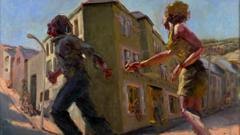
The valleys of South Wales used to be painted in shades of industrial ash. Artists typically reached for dark charcoals and moody greys to capture a landscape supposedly crushed by coal and heavy labor. Then Kevin Sinnott picked up a brush.
Sinnott didn't care for dreary clichés. When he passed away at his home in Pont-y-rhyl at age 78, he left behind a visual vocabulary that completely redefined modern Welsh art. His canvases exploded with saturated yellows, brilliant reds, and sunlit figures that proved life in the valleys was vibrant, messy, and deeply human.
If you want to understand why his death feels like an earthquake to the cultural community, you have to look past the standard obituary notices and examine what he actually did on the canvas.
The Man Who Painted Wales in Technicolor
Born in Sarn, near Bridgend, in 1947 to Irish parents, Sinnott took the long road through the British art education system. He studied at Cardiff College of Art and Design, Gloucester College, and eventually the prestigious Royal College of Art in London. He spent the 1970s and 1980s grinding away in London galleries, scoring major international exhibitions, including a sell-out show in New York.
Many artists stay away once they find success in global capitals. Sinnott did the opposite.
In 1995, he packed up and moved back to Wales, settling right back into the community that fed his imagination. That same year, he produced his magnum opus: Running Away with the Hairdresser.
Decoding Running Away with the Hairdresser
That single painting changed everything. Housed permanently at the National Museum Wales in Cardiff, the monumental canvas features three figures in motion across a hilly Welsh backdrop. A woman in a bright dress sprints across the landscape, trailing loose hair and an electric sense of sudden freedom.
Art critics love to throw around words like iconic, but this painting earned the title. It hangs proudly in the national consciousness alongside Sydney Curnow Vosper's famous Salem, yet it speaks an entirely different emotional language. It isn't about rigid piety or historical gloom. It is about impulse, theatricality, and the sudden urge to blow up your life for something new.
Sinnott managed to capture human relationships without making them sentimental. Figures lean into each other, pull away, dance, or stare into space with a theatrical gravity. His brushstrokes were bold, confident, and unapologetically physical. You could see the wrist movement in the paint. You could feel the weather.
Beyond the Gallery Walls
Global institutions quickly noticed. His work found its way into the Metropolitan Museum of Art in New York, the British Museum, and the Arts Council of Great Britain. Yet, despite international acquisition lists that would inflate anyone's ego, Sinnott remained remarkably grounded.
People who ran regional Welsh auctions and community gallery spaces remember him for a complete lack of pretension. He wasn't an aloof genius hiding in a studio. He showed up, supported local charities like City Hospice, donated exceptional pieces to causes he cared about, and talked to anyone who walked through the door.
He treated the small towns of South Wales as epic theaters worthy of grand-scale narrative painting.
What Happens to the Legacy Now
The market for his work has always been fierce. When pieces like In the Wind or Pont y Rhyl cross the auction block, they spark intense bidding wars. Collectors recognize that artists of his caliber—those who can anchor a distinct cultural identity while speaking a universal visual tongue—don't come along twice in a generation.
Yet his true legacy isn't financial. It is permission.
Sinnott gave subsequent generations of Welsh painters permission to throw away the grey palette. He proved that local stories do not need local limitations to matter. He proved that brilliant light exists even in steep valleys, provided you have the vision to look past the coal dust.
Take a trip to Cardiff and stand in front of his canvases. Look at the way the colors vibrate against one another. That is how you keep an artist alive.