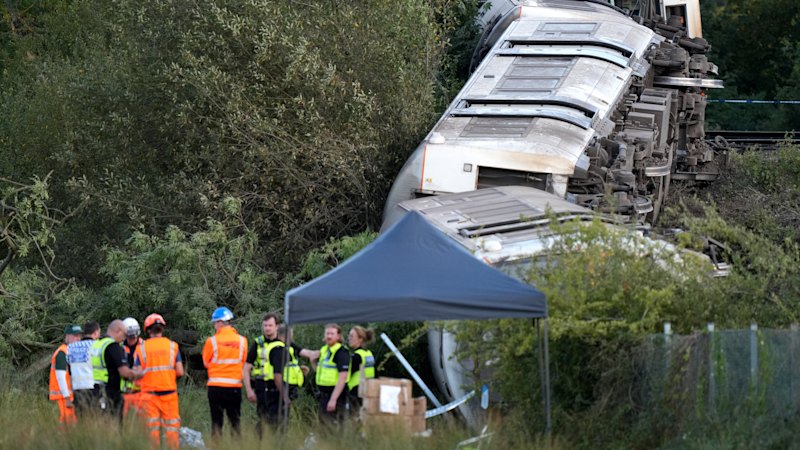
Everything went topsy-turvy in a matter of seconds. A passenger train running from London Victoria to Eastbourne jumped the tracks near Lewes in East Sussex, sending three carriages onto their sides and triggering a major emergency response.
If you are trying to figure out what happened on Thursday afternoon, you aren't alone. Thousands of commuters and families want clear answers about safety, injuries, and travel disruptions. Here is the breakdown of the incident based on official statements from the British Transport Police, Network Rail, and passenger accounts.
What Happened on the Tracks
The train involved was the 2:24 PM Southern Railway service carrying roughly 150 passengers. Shortly before 4:00 PM on August 13, 2026, the rear three carriages of the eight-car Electrostar train derailed just north of the Lewes Tunnel between Cooksbridge and Lewes.
Passengers described violent shaking that felt like severe air turbulence. The train picked up speed before the emergency brakes engaged abruptly. Laptops, bags, and loose items flew forward as the carriages began to tilt.
The last three cars tipped entirely onto their sides on the heathland beside the tracks. Initial reports from the scene showed passengers climbing out of shattered windows and standing on top of the toppled carriages while waiting for help.
Injuries and Emergency Response
Emergency services declared a major incident immediately. The South East Coast Ambulance Service deployed dozens of staff members, alongside three air ambulances and multiple Hazardous Area Response Teams.
Ten fire engines rushed to the site alongside British Transport Police officers. Out of the 150 people on board, authorities confirmed that 20 people required hospital treatment. Two individuals sustained serious injuries, while 18 others suffered less severe injuries like cuts and deep bruising.
Passengers who escaped without serious physical harm were taken to a nearby community centre. Local partner agencies and volunteers met them there to provide water, first aid, and support.
The Investigation and Immediate Suspicions
Why did the train derail? Right now, nobody knows for certain. The Rail Accident Investigation Branch deployed a team of inspectors to the site immediately to gather black box data, examine the rolling stock, and look closely at the infrastructure.
Network Rail and Southern Railway are cooperating fully with the probe. Transport Secretary Heidi Alexander called the reports deeply concerning and confirmed that federal and industry officials are working around the clock to support victims.
Speculation among passengers has naturally turned toward the weather. Southern England was baking under high summer temperatures reaching above 30 degrees Celsius on Thursday. Some travelers suggested that extreme heat may have caused the rails to buckle, a known phenomenon on older steel networks when expansion joints fail. However, investigators have explicitly warned against jumping to conclusions before technical evidence is analyzed.
Current Travel Chaos and What Commuters Should Do
The derailment has completely paralyzed rail lines across East Sussex. All services between Lewes and Brighton, Eastbourne, Haywards Heath, and Seaford remain suspended.
National Rail issued a strict "do not travel" advisory for the region. Major disruption is expected to persist as recovery crews work to clear the heavy carriages and repair damaged tracks.
If you rely on this route for your regular commute, cancel your travel plans for the immediate future or look for alternative coach services. Check live station boards or online journey planners before heading out, as timetable updates are changing hour by hour.