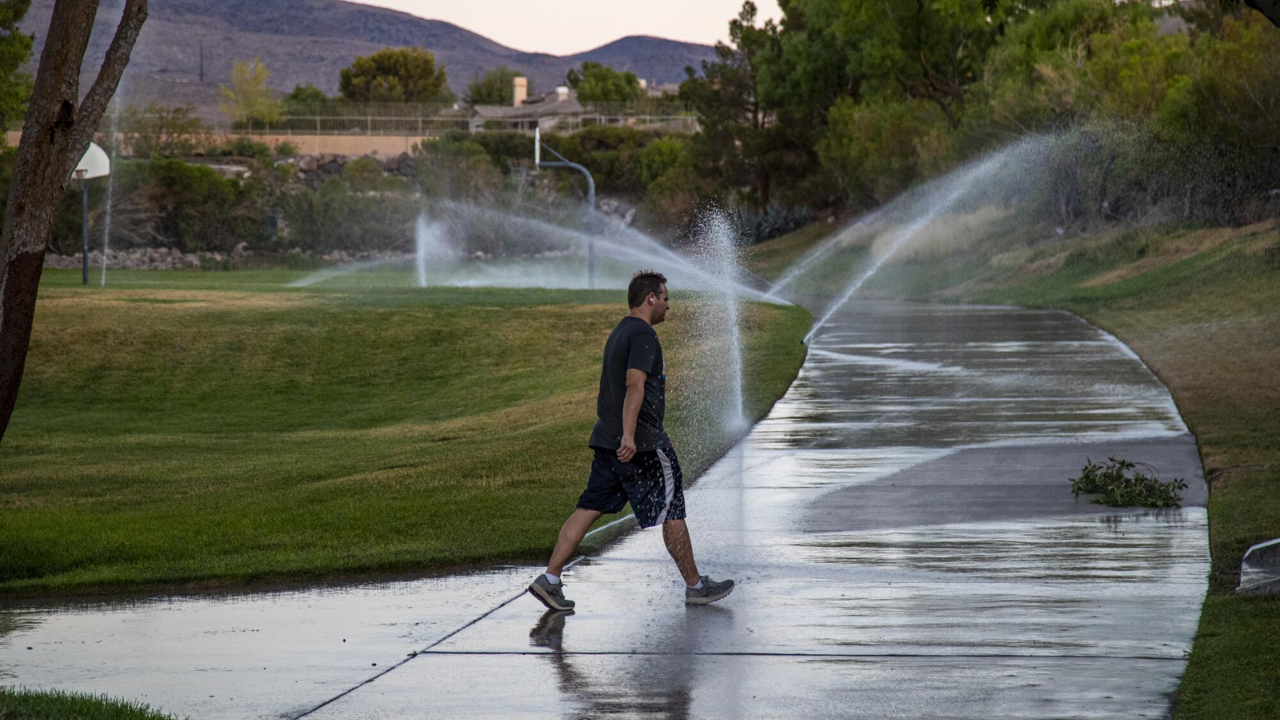
You rip out your green grass. You trade it for gravel, rocks, and drip-fed desert brush. You save millions of gallons of water. Then, summer hits, and your backyard feels like an active oven.
That is the trade-off playing out right now across the American Southwest.
The Las Vegas Valley has stripped out an astonishing 250 million square feet of non-functional turf grass since 1999. Backed by the Southern Nevada Water Authority’s Water Smart Landscapes rebate program—which pays property owners up to $5 per square foot to ditch their lawns—and legal mandates like Assembly Bill 356, the desert metropolis has pulled off a massive conservation feat.
They saved 203 billion gallons of water.
Yet, recent environmental research points to an unintended penalty. Getting rid of grass kills its natural cooling effect, sending local summer land-surface temperatures soaring.
The Physics Behind the Desert Heat Trap
Grass is basically a natural swamp cooler. Through evapotranspiration, turf grass sucks moisture from the soil and releases it into the air, keeping its immediate surroundings noticeably cooler than the surrounding desert air.
When you replace that living green carpet with bare gravel, concrete, or synthetic turf, you remove that moisture barrier entirely.
A study published in the academic journal Urban Climate looked closely at this phenomenon in the Las Vegas Valley. Researchers discovered that removing turf grass spiked summer land-surface temperatures by roughly 20 degrees Celsius (20 ± 0.3 Kelvin).
To put that in perspective, general urbanization typically raises land-surface temperatures by about 5 degrees Celsius. The localized heat spike caused by ripping out a lawn dwarfs standard urban warming trends.
Of course, commercial rooftops, parking lots, and asphalt roads remain the dominant drivers of the wider urban heat island effect across the valley. But property owners trading grass for gravel are unintentionally turning their yards into micro-furnaces.
Why Las Vegas Had No Choice
Lake Mead provides about 90 per cent of the drinking water for southern Nevada. Over the past two decades, prolonged drought and overallocation along the Colorado River have pushed the reservoir down to terrifyingly low levels.
Water managers face a brutal mathematical reality. Indoor water use in Las Vegas is heavily recycled. Sinks, showers, and toilets drain into wastewater treatment plants, where the water gets cleaned and returned to Lake Mead.
Outdoor water use is a completely different story. Water sprayed onto decorative grass evaporates into thin air. It cannot be recovered.
According to estimates from the Southern Nevada Water Authority, replacing decorative lawns with xeriscaping slashes outdoor water use on targeted commercial, multi-family, and residential properties by up to 55 per cent. When federal limits on Colorado River water tighten, cutting outdoor irrigation isn't optional. It is survival.
Fixing the Dry Desert Heat Problem
So, how do you save a vital river system without turning neighborhoods into literal griddles?
Urban planners and water agencies are shifting tactics. Instead of replacing lawns with bare stone or blazing hot artificial turf, experts now advocate for strategic urban forestry.
Property owners are encouraged to plant deep-rooted shade trees supplied by targeted underground drip systems. These trees drop temperatures by casting shadows and providing localized cooling without demanding the massive water volume required by traditional turf grass.
Regional rules now outright ban new grass installations in the front and back yards of single-family homes across the valley. The objective has shifted from simple lawn eradication to smart desert adaptation.
Conserving water and keeping cities liveable requires a delicate balance. Las Vegas proved it can mobilize millions of square feet of change. Now, the valley has to figure out how to live with the heat it left behind.