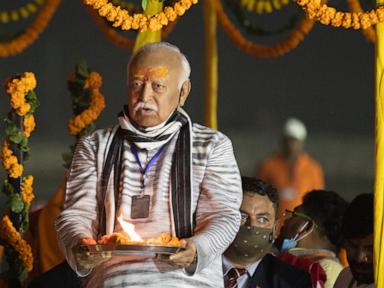
When a high-profile foreign political leader books a major venue in the heart of Manhattan, you expect a mix of supporters and local chatter. But when Mohan Bhagwat, chief of India's Rashtriya Swayamsevak Sangh (RSS), stepped up to address thousands inside Madison Square Garden's Infosys Theater, he walked into a firestorm. Protesters didn't just stand outside with signs; they mobilized an entire coalition of interfaith, civil rights, and diaspora groups demanding visa revocations and U.S. government sanctions.
Why is an organization founded a century ago in Nagpur, India, drawing sharp federal scrutiny and street-level fury in New York City? The answer lies in the global expansion of Hindu nationalism and the deep ideological fault lines splitting the Indian American diaspora.
Understanding the Roots of the RSS and Hindutva
If you want to understand modern Indian politics, you can't ignore the RSS. Established in 1925, the Rashtriya Swayamsevak Sangh operates as a right-wing, paramilitary-style volunteer organization. It functions as the ideological parent of the Bharatiya Janata Party (BJP), India's current ruling party led by Prime Minister Narendra Modi.
The core ideology promoted by the group is Hindutva, often translated as "Hinduness" or the essence of being Hindu. While supporters frame this concept around cultural unity, ancient Sanskrit traditions, and universal family values like Vasudhaiva Kutumbakam ("the world is one family"), critics see a different reality. Human rights watchdogs and diaspora organizations argue that Hindutva seeks to convert India's secular democracy into an exclusionary Hindu nation where minorities—particularly Muslims and Christians—face systemic marginalization, mob violence, and property demolitions.
When Bhagwat brought this messaging to New York, the pushback was immediate and fierce.
The Clash Over New York City Real Estate and Values
The Madison Square Garden event was organized as a collaborative effort involving more than 200 Hindu American groups, celebrating themes of community responsibility and cultural heritage. Yet, the local political response was ice-cold. New York City Mayor Zohran Mamdani publicly condemned the gathering, calling the ideology of the RSS fundamentally exclusionary and antithetical to the pluralistic values of the city.
Meanwhile, groups like the Hindu American Foundation defended the assembly, arguing that local politicians have a duty to protect all residents regardless of political or religious beliefs, and urged attendees to remain vigilant amid the rising tension.
Outside the venue, the scene was entirely different. Activists from North Carolina, local interfaith leaders, and progressive members of the diaspora gathered to push back. For many Indian American Muslims, Sikhs, and Dalits, the normalization of RSS ideology in Western capitals feels like a direct threat. They point out that the RSS maintains hundreds of centers across the United States, quietly influencing political discourse and fundraising within the diaspora.
Calls for Federal Sanctions and Political Pledges
The controversy didn't stop at city lines. Days before the New York speech, the U.S. Commission on International Religious Freedom (USCRIF)—a bipartisan federal advisory body—urged Washington to weigh sanctions against RSS members and consider revoking Bhagwat's visa. The commission cited ongoing concerns regarding religious freedom violations and minority targeted violence in India.
Predictably, India's Ministry of External Affairs rejected the recommendation, dismissing the commission as biased and lacking credibility.
At the same time, domestic political pressure has scaled up. Nearly 100 U.S. elected officials recently signed a pledge to reject campaign donations tied to Hindu nationalist organizations. Activists argue that tracking and cutting off transnational political money is the only way to stop extremist ideologies from taking root in American civic life.
If you are watching how international political conflicts migrate into Western democratic spaces, this event serves as a defining case study. It proves that the future of secular pluralism isn't just being fought in New Delhi or Mumbai—it's being argued on the streets of New York.
Protests Erupt in New York Over RSS Chief Mohan Bhagwat's Visit
This video provides on-the-ground footage of the demonstrations outside Madison Square Garden during Mohan Bhagwat's controversial New York City speech.
http://googleusercontent.com/youtube_content/1