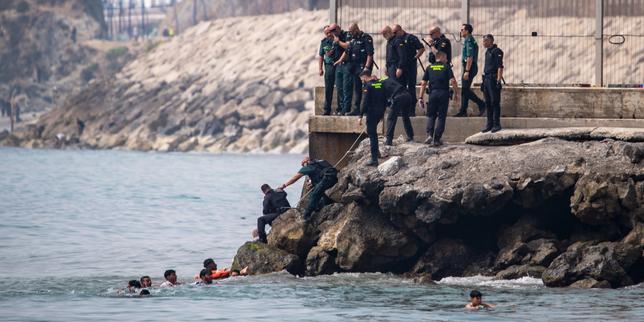
Fifteen hundred people. That is the stark number dominating headlines right now as regional authorities in Ceuta sound the alarm over an absolute humanitarian emergency. Over the past few days, hundreds of individuals have crossed from Morocco into the Spanish enclave, pushing local reception systems past their absolute breaking point.
You see headlines like this pop up every few months. Numbers flash across screens. Officials express shock. Then the news cycle shifts, leaving local communities to deal with the fallout of a geopolitical friction point that never truly cools down.
Let's look past the initial shock value of the latest influx. What is actually happening on the ground in Ceuta, why do these sudden surges keep happening, and what does it mean for the broader migration landscape between Europe and North Africa?
The Pressure Cooker at the Border
Ceuta isn't just a border town. It is a tiny slice of European Union territory physically attached to the African continent, sharing a heavily fortified land border with Morocco. That geographic reality makes it an eternal magnet for people desperate to reach Europe.
When regional authorities label a situation an absolute humanitarian emergency, they aren't using hyperbole for dramatic effect. Local shelters are overflowing. Emergency housing units are stretched to maximum capacity. Social workers and medical staff are working around the clock without adequate sleep or resources.
The immediate trigger for these sudden spikes often involves a mix of weather conditions, shifts in local enforcement patterns, and deep economic desperation driving young people to take extreme risks. A calm sea or a momentary lapse in surveillance creates an immediate opening. People take it because the alternative back home feels far worse.
Why Border Fortifications Alone Never Solve the Problem
Politicians love quick fixes. Build a higher fence. Add more cameras. Deploy more security forces.
Yet, the arrival of over fifteen hundred people in a matter of days proves that walls only change the shape of the problem. They don't erase the push factors. People fleeing poverty, lack of opportunity, or instability in parts of Africa view the Spanish border as a golden door, regardless of the razor wire standing in their way.
"When survival is on the line, physical barriers become obstacles to overcome rather than permanent deterrents."
Local authorities in Ceuta find themselves caught in the middle of a massive diplomatic chess game. They manage the immediate human crisis, but the real decisions happen thousands of kilometers away in Madrid and Brussels.
The Diplomatic Balancing Act Between Spain and Morocco
You cannot talk about migration in Ceuta without talking about Rabat. Spain's relationship with Morocco is complex, fragile, and utterly vital for border management.
Cooperation between the two nations dictates whether crossings drop to a trickle or spike dramatically. When diplomatic relations are warm, Moroccan security forces clamp down hard on staging areas near the border. When tensions rise or diplomatic channels hit a rough patch, enforcement can loosen, resulting in immediate surges at the fences or along the coast.
This dynamic leaves the enclave of Ceuta perpetually vulnerable to external political weather. Local residents and regional politicians bear the brunt of geopolitical shifts they have zero control over.
What Happens to the People Who Make It Across
Reaching Ceuta is only the first step of an exhausting labyrinth. Once individuals arrive, they enter a complex bureaucratic process involving identification, medical screening, and temporary placement in overcrowded reception centers.
Most migrants do not want to stay in Ceuta. The enclave is geographically isolated, job opportunities are scarce, and movement to the European mainland is tightly restricted. Yet, transfers to the Spanish peninsula take time, often leaving people stuck in limbo for weeks or months.
Humanitarian organizations step in to fill the gaps, providing food, psychological support, and legal aid. But volunteers are exhausted. The sheer volume of arrivals overwhelms the charity infrastructure designed to handle steady, manageable numbers, not sudden human waves.
The Broader European Blind Spot
Europe's approach to migration remains reactive rather than proactive. Millions are spent on border tech, yet long-term integration strategies and fair asylum processing systems lag behind.
When an emergency hits Ceuta, European capitals express solidarity with quick statements. Real financial and logistical backing often arrives too late to ease the immediate strain on local municipalities.
If European leaders continue to treat every migration spike as an isolated crisis rather than a permanent structural reality, towns like Ceuta will face the same breaking point year after year.
The fifteen hundred people who arrived in recent days are human beings caught in a system that struggles to see them as anything other than a statistic. Until the underlying economic and diplomatic imbalances are addressed at their root, the fence at Ceuta will remain a flashpoint where desperation meets resistance.