You take a single wrong step on an unmarked alpine route, and the mountain instantly changes its mind about letting you live. That is the brutal reality of the Sierra Nevada. High-altitude terrain doesn't care about your experience level, your gear, or how many peaks you've already checked off your list.
Take the recent emergency on Laurel Mountain. An experienced climber found himself stranded on a terrifying six-inch ledge, hovering more than 10,000 feet above the valley floor. One slip meant certain death. What followed wasn't just a standard mountain rescue; it was a masterclass in grit, high-stakes volunteer coordination, and why local search and rescue teams are the unsung heroes of America's rugged backcountry.
The Danger of the Mendenhall Couloir
Climbing Laurel Mountain sounds like an epic weekend adventure until you get onto the face of the Mendenhall couloir. The route is steep, punishing, and littered with loose rock that shifts under your boots like ball bearings. It's the kind of place where navigation mistakes happen in seconds.
The stranded climber veered off the established path by accident. According to the Mono County search and rescue team, going off-route in this area quickly traps you on vertical, un-protectable fifth-class terrain. You can't go up, you can't go down, and you have thousands of feet of sheer drop beneath you.
When the local sheriff's office got the call, the clock started ticking immediately.
Why Helicopters Couldn't Save Him
Most people assume modern mountain rescues involve a chopper dropping down from the sky, lowering a harness, and whisking the victim away. Movies love that trope. Reality is much harsher.
Powerful winds blasted the mountain face, making a helicopter hoist operation far too risky. If the pilot tried to hover near that cliffside, rotor wash could easily knock the climber off his microscopic perch.
That left only one option. The Mono County volunteers had to go in on foot.
And they had to do it in the dark.
Navigating by Headlamp in the Dead of Night
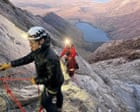
Imagine scrambling up vertical, crumbling rock while relying entirely on a headlamp beam to pick your footing. It sounds like a mountaineering nightmare, because it is.
Rescue team members scaled the treacherous terrain at night, operating on pure trust and adrenaline. As rescuer Mitchell Quiring pointed out to the press, terrain that's tricky during the day becomes entirely unnavigable after dark. But leaving the man stranded overnight wasn't an option. His legs were already cramping from shifting his weight back and forth on that six-inch strip of rock, and hypothermia or exhaustion would have sent him tumbling before sunrise.
The team searched for two hours before finally hearing a distant voice cutting through the mountain wind.
Once they reached him from overhead, rescuers secured the climber with a rope system to anchor him against the abyss. They worked through the early hours of Sunday morning to bring him down safely.
What Most People Get Wrong About Backcountry Safety
People look at stories like this and assume it only happens to reckless novices who ignored warnings. That's false. Even seasoned climbers make mistakes, misread routes, or get caught out by shifting conditions.
Mountains punish overconfidence. If you're planning a trek into remote ranges like the Sierra Nevada, you need to respect a few hard truths:
- GPS apps fail. Batteries die in the cold, and satellite signals bounce off canyon walls. Always carry a physical map and compass, and know how to use them.
- Turnaround times matter. Stubbornness kills. If you are falling behind schedule or losing the trail, turning back is a success, not a failure.
- Local volunteers save lives. Professional agencies often rely on unpaid, highly skilled volunteers who drop everything to search freezing wilderness in the middle of the night. Support local search and rescue organizations whenever you can.
The climber on Laurel Mountain survived because he didn't give up. He pushed through the panic, kept his footing, and trusted the people who came looking for him. Next time you head out into the backcountry, pack like your life depends on it—because eventually, it might.