Natural disasters rarely leave behind neat statistics. They leave chaos, silence, and logistical nightmares that normal systems simply aren't built to handle. When catastrophic flash floods tore through Nepal following extreme weather and a glacier-related collapse near the Tibet border, the world watched the dramatic rescue operations on screen. But what happened after the cameras stopped rolling tells a much darker, brutally honest story about disaster management in South Asia.
Local mortuaries didn't just fill up. They overflowed almost immediately.
The Mortuary Collapse and the Chitwan Overflow
Let's talk about the raw scale of the infrastructure failure. In typical times, district hospitals in regions like Chitwan can manage standard local fatalities with standard morgue capacity—usually holding roughly 30 to 50 bodies maximum. But the 2026 floods changed the arithmetic entirely. Flash floods along rivers like the Trishuli and Bhote Koshi didn't just strike locally; they acted as violent conveyor belts.
Bodies from upstream districts like Rasuwa and Nuwakot were swept over a hundred kilometers downstream, depositing an overwhelming human toll right into the lap of Chitwan and surrounding low-lying areas. Hospitals were staring at a catastrophic mismatch between capacity and reality.
Local medical staff were forced to make impossible choices. When you run out of stainless-steel cold storage boxes, body bags start piling up in hallways. That's not a hypothetical scenario—that was the stark reality on the ground.
Turning Empty Corporate Spaces into Temporary Morgues
Desperation breeds unorthodox logistics. Because standard medical facilities hit their breaking point within hours, state and local authorities had to pivot fast.
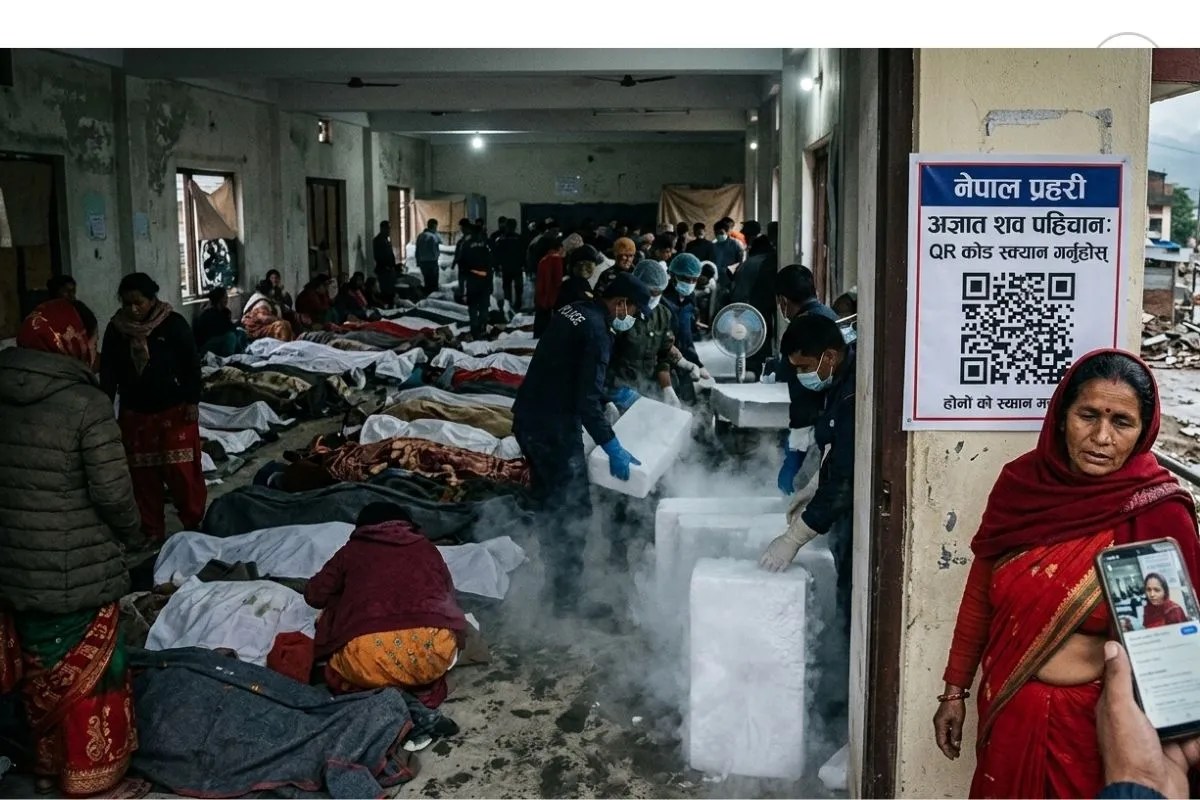
They looked at empty commercial real estate. In Bharatpur Metropolitan City, officials took over a vacant structure belonging to the Industrial Enterprise Development Institute, transforming an industrial training space into a makeshift, mass holding center. While local morgues maxed out at 50 bodies, this massive temporary facility was hastily scaled up to handle a projected 250 to 500 bodies.
It's a grim reminder of how disaster preparedness requires thinking outside the box. You don't build morgues during a crisis; you repurpose whatever concrete walls you have left standing.
Dry Ice, AC Units, and the Fight Against Time
Keeping human remains preserved in tropical lowland heat without an industrial refrigeration grid is a race against biology. Electricity lines were battered, backup generators were strained, and normal cold-chain infrastructure failed.
To slow down decomposition in these makeshift holding centers, authorities deployed heavy-duty air conditioning units paired with massive quantities of dry ice. Solid carbon dioxide sublimation became a frontline medical tool. Workers hauled blocks of dry ice into empty industrial halls to maintain sub-zero microclimates around makeshift rows of body bags.
It's crude. It's exhausting. But when standard morgues fail, dry ice buys time for grieving families who haven't even found their missing relatives yet.
The QR Code Revolution in Missing Persons Tracking
Identifying bodies washed down by swollen Himalayan rivers is heartbreakingly difficult. Traditional visual identification at crowded hospital gates often causes secondary trauma for families searching through mud-caked rows of victims.
Nepal Police handled this digital-era crisis by leveraging modern tech tools. Law enforcement agencies compiled detailed physical descriptions and logged photographic records of unidentified victims, publishing a centralized system accessible via a digital QR code distributed on official social media channels.
Instead of forcing villagers to travel hundreds of kilometers across washed-out bridges just to check a clipboard at a hospital desk, families can scan the QR code from relief camps or temporary shelters to cross-reference details of missing loved ones. It's a modern workflow adaptation that saved countless hours of agonizing uncertainty.
What This Crisis Teaches Us About Future Disasters
The numbers coming out of the disaster zones are staggering—hundreds confirmed dead and well over a thousand missing as rivers rearranged entire valleys. But the real takeaway isn't just about the weather event itself. It's about systemic readiness.
Most mountain and valley communities across the region treat disaster response as an evacuation problem. They plan for boats, helicopters, and temporary food distribution. What they consistently fail to budget for is the grim backend logistics of mass fatality management.
When rivers swallow entire villages, the infrastructure challenge doesn't end when the rain stops. It ends months later when the last body is identified, claimed, and laid to rest with dignity. Until local governments build permanent redundancy into their mortuary networks—or maintain pre-arranged stockpiles of mobile cold-storage containers and dry-ice supply chains—ad-hoc solutions like empty industrial halls will remain the default safety net.
If you're studying disaster logistics or emergency planning, look past the rescue footage. Pay attention to what happens to the spaces left empty when the water recedes. That is where the true test of a state's resilience happens.