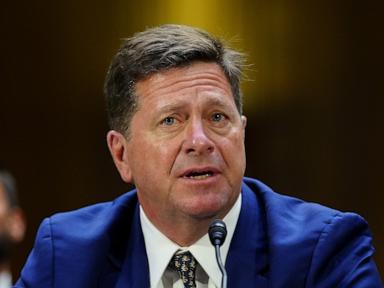
The United States Senate just confirmed Jay Clayton as the new Director of National Intelligence. The vote split entirely down party lines at 51 to 47. It brings a permanent chief back to the Office of the Director of National Intelligence after weeks of turbulence, but it doesn't solve the deep political fractures surrounding the nation's spy apparatus.
If you're wondering why this matters right now, look at what's sitting on the legislative table. Clayton steps into the role during a record-long lapse of key government surveillance powers and fierce fights over election narratives. He replaces interim chief Bill Pulte, whose brief tenure upended agency routines. Recently making waves in related news: What The Proposed Us Transfer Of 60000 Heavy Bombs To Israel Actually Means.
Who Is Jay Clayton And Why The Pushback
Clayton isn't a career intelligence officer. He previously chaired the Securities and Exchange Commission during Trump's first administration and served as the U.S. Attorney for the Southern District of New York.
Republicans argued his prosecutorial background gave him enough muscle to handle national security threats. Senators pointed to his oversight of terrorism prosecutions and international drug-trafficking indictments. Additional information on this are covered by Al Jazeera.
Democrats saw things differently. During his confirmation hearings, Clayton faced sharp questioning about election integrity. Pressed by lawmakers, he declined to state outright that Joe Biden won the 2020 election. Instead, he used the careful formulation that Biden had been "certified" through the Electoral College.
That language enraged Senate Democrats. Virginia Senator Mark Warner, the top Democrat on the intelligence committee, voiced bitter disappointment. Over four hundred former intelligence officials also publicly opposed the nomination, arguing Clayton lacked the statutory national security expertise mandated by Congress after the September 11 attacks.
The Section 702 Stalemate
Clayton's installation is meant to unclog a major legislative bottleneck. Negotiations to renew Section 702 of the Foreign Intelligence Surveillance Act have stalled for weeks.
This controversial surveillance tool allows the National Security Agency to target foreign intelligence assets overseas without a warrant. Critics hate it because it routinely sweeps up the communications of everyday Americans during those collections.
Democrats previously walked away from renewal talks following the appointment of interim leader Bill Pulte. Senate Majority Leader John Thune hopes Clayton's arrival changes the math. Thune and other Republicans want lawmakers to stop blocking the spy program's reauthorization.
At the same time, the White House insists that any spying renewal must link up with broader voting legislation like the SAVE America Act. That bill requires strict voter ID and proof of citizenship, creating a massive partisan wall inside an already divided 53-47 Senate.
What Interim Chief Bill Pulte Left Behind
You can't understand Clayton's starting line without looking at what happened right before he took the oath. Bill Pulte spent weeks running the agency as an acting director.
Pulte acted as a loyalist charged with massive transparency efforts. He oversaw the declassification of thousands of documents related to alleged foreign interference in past elections. He also claimed a dramatic down-sizing of the central office, cutting staff by roughly thirty percent near the end of his brief run.
Critics argue those moves politicized an agency meant to remain neutral. Supporters cheered the transparency. Clayton now inherits a lean, bruised, and deeply scrutinized intelligence community.
The Real Test Ahead
Clayton controls the coordination of eighteen different intelligence agencies and oversees the President's Daily Brief. His immediate job involves rebuilding trust with skeptical lawmakers while navigating a hostile international threat landscape.
He must prove he can keep intelligence separate from political narratives. If he fails to balance those pressures, expect the friction on Capitol Hill to intensify before the year ends.