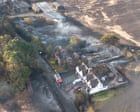
Flames don't care about postal codes. They don't check if they are burning rural brushland in Croatia or suburban streets in the West Midlands. When a massive wildfire tore through a 40-acre patch near Stourbridge, forcing emergency services to treat dozens of people and hospitalize individuals, it shattered the comfortable illusion that extreme blazes only happen in Mediterranean pinewoods or remote Californian forests.
This isn't distant news happening to other people. It's happening right outside our windows.
Across Europe, millions are sweating through suffocating heat spikes topping 35°C, while historic towns like Omiš in Croatia evacuate thousands of residents and tourists as walls of fire march toward the Adriatic coast. Meanwhile, British infrastructure is buckling under the strain. If you think this is just a normal summer, you're missing the entire reality of how vulnerable our local neighborhoods actually are.
What Actually Happened on the Ground
Let's look at the facts without the panic filter. In the UK, the West Midlands Fire Service faced what Chief Fire Officer Simon Tuhill called the most challenging incident they have ever encountered. Up to 100 firefighters battled a ferocious blaze spanning the equivalent of over 20 football pitches. Houses on Quarry Park Road and Norton Road were gutted, turning suburban properties into ash zones in a matter of hours.
Paramedics treated 54 patients at the scene, with 19 people rushed to hospital. Let that number sink in. Nineteen human beings needing acute medical care because a patch of dry scrub turned into an unstoppable blowtorch near residential homes.
Down in Croatia, the situation mirrored a disaster movie script. Around 1,000 people, including hundreds of foreign tourists, had to be evacuated overnight as wildfires ripped through Lokva Rogoznica and threatened Omiš. Croatian Prime Minister Andrej Plenković rushed to the site, calling it one of the worst fires in recent years, with dozens injured and several fighting for their lives in critical condition.
Why Modern Infrastructure Is Unprepared
We build our towns for rain, wind, and the occasional mild frost. We do not build them for flash-dried vegetation and ember storms.
When long stretches of dry weather strip moisture from local parks, fields, and urban fringes, ordinary grass transforms into kindling. A single discarded cigarette, a stray spark, or an illegal disposable barbecue can trigger a chain reaction that completely outpaces local emergency response times.
Fire doesn't just travel along the ground. High winds lift burning embers, carrying them hundreds of meters over roads and firebreaks to land straight on dry roof tiles or back gardens. That's why suburban areas in Stourbridge suffered heavy structural damage just as easily as traditional wildfire zones in southern Europe.
The Broader European Picture
It's tempting to view these events as isolated bad days. They aren't. From Germany—where hundreds were evacuated in Hürtgenwald near the Belgian border—to scorched regions in France and Greece, the continent is caught in a synchronized pressure cooker.
Over 150 million people are enduring dangerous heat levels simultaneously. Reservoirs are dropping, crops are baking into dust, and emergency responders are stretched dangerously thin. When every region needs specialized equipment, aircraft, and hazardous response teams at the exact same time, backup simply doesn't arrive as fast as it should.
What You Can Do Right Now
Sitting back and hoping for rain is a terrible strategy. If you live near open fields, dry parklands, or wooded suburban edges, you need to treat wildfire prevention as a personal responsibility.
Clear dry brush and dead leaves away from your property line. Ditch disposable barbecues entirely during dry spells—local authorities are already pushing for outright bans because people refuse to exercise basic caution. Keep an emergency go-bag ready with essential documents, medications, and water if local authorities issue warning alerts.
The climate isn't changing eventually. It has already changed. Stop treating these disasters as statistical anomalies and start treating them like the new normal.