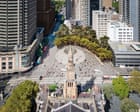
Forty-four years is a long time to wait for a patch of open ground. Back in 1982, the City of Sydney started quietly purchasing properties opposite its historic Town Hall with a single, grand objective: build a proper public plaza. Decades passed, mayors came and went, and those buildings largely sat there. Now, the long-gestating plan for a 4,500-square-metre Sydney plaza is finally moving from political football to concrete reality.
Lord Mayor Clover Moore just released the fresh architectural renders for the project. It carries a hefty $150 million price tag covering design, property acquisition, lease terminations, and demolition. If you spend any time walking through the CBD, you know this part of George Street is a chaotic bottleneck. Nearly 200,000 commuters push through this transit hub daily, dodging buses, heavy rail exits, light rail lines, and metro crowds.
So, what is the city actually planning to build? And why did it take over four decades to get here? Let's look at the details.
Breaking Down the Town Hall Square Design
The new layout centers on a massive open public square framed by a curved perimeter of native Australian trees. Architecture firms JPW and ASPECT Studios handled the concept, opting for circular paving patterns that direct eye-lines toward the heritage façades of the Town Hall and St Andrew's Cathedral. A central water feature anchors the open space, designed to cool down the concrete microclimate during harsh summer months.
Sydney doesn't have a grand civic gathering space on the scale of European squares like Rome's Piazza Navona or Vienna's Stephansplatz. Moore has frequently cited those overseas trips as inspiration. Yet, designers insist this layout will lean into local identity rather than copying a foreign template. The native tree canopy will shift colors across seasons, offering shade when the mercury spikes and letting winter sun into the plaza.
The funding is locked in. The City of Sydney claims the $150 million cost is fully accounted for within its long-term financial framework, meaning it won't rely on unexpected emergency borrowing.
Why the Project Stalled for More Than Forty Years
Urban planning moves slowly, but this timeline is extreme even by government standards. Buying up seven separate commercial properties across an entire block bounded by George, Pitt, and Park streets is an administrative nightmare. Existing commercial leases had to run their course, property owners fought compulsory acquisitions, and shifting council majorities argued over priorities.
For years, critics questioned whether the city should spend massive sums of public money buying up prime CBD real estate just to knock it down. Past administrations hesitated. It wasn't until the pedestrianisation of George Street—which stripped cars out of the corridor and proved that public spaces could attract billions in private investment—that momentum became unstoppable.
When the council bought the final piece of the puzzle in 2025, the last major roadblock disappeared.
Managing the Growth Spike by 2050
Sydney's population is projected to double by 2050. Packing more residents and office workers into a tight geographic peninsula bounded by water means public domain space is at a premium.
Commuters currently spill off train platforms directly into cramped walkways. The square aims to act as a pressure valve, giving people room to breathe between transit modes. Beyond everyday foot traffic, the council intends to use the plaza as an outdoor venue for festivals, night markets, and live sites for sporting events.
Before you grab your calendar, keep in mind that construction isn't starting tomorrow.
What Happens Next on the Timeline
If you want to track the progress or voice your opinion, here are the upcoming milestones:
- Late 2026: The council formally lodges the development application, opening a public feedback window for residents and local businesses.
- 2027: Preliminary public domain upgrades begin in the immediate area between Town Hall and the cathedral.
- 2028: Heavy demolition of the remaining acquired buildings kicks off.
- 2031: The completed plaza opens to the public, tentatively slated to receive an official Indigenous place name drawn from local Aboriginal language.
Expect plenty of traffic disruptions along George Street once the heavy machinery rolls in. Whether this plaza transforms the CBD into a world-class civic hub or turns into an expensive concrete wind tunnel depends entirely on how well the execution matches the glossy renders.
Review the upcoming development application drafts on the City of Sydney website to submit your feedback before the consultation window closes.