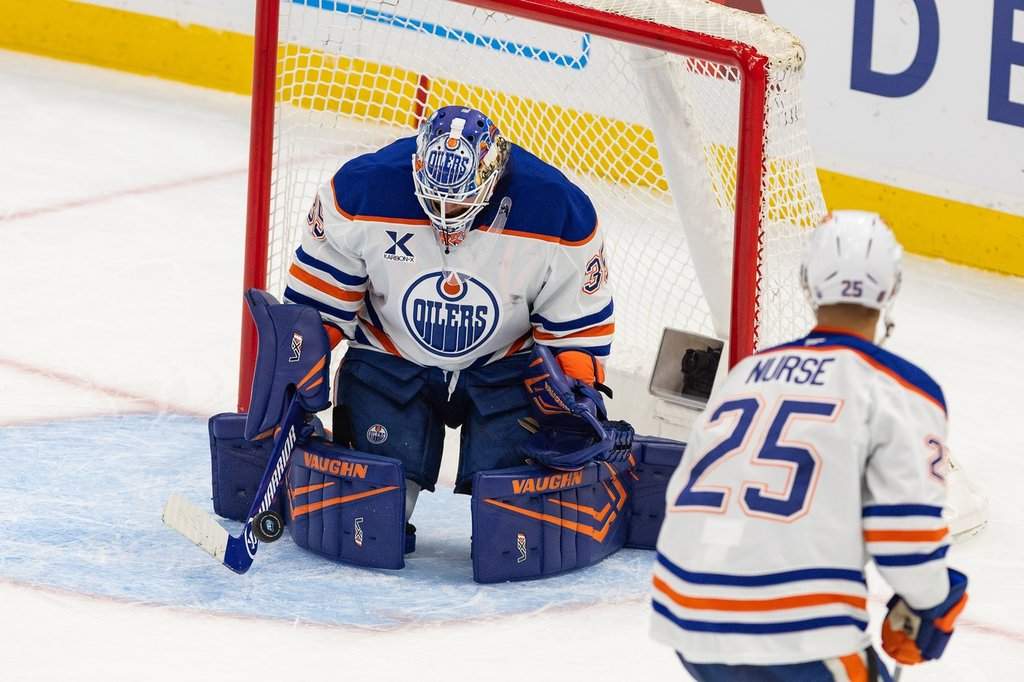
Goalie battles in Edmonton always turn into a circus. When you throw Tristan Jarry into a crowded training camp mix alongside Frederik Andersen and young prospect Devon Levi, the temperature rises immediately. Everyone wants a definitive answer on who starts opening night, but hockey rarely hands you clean scripts. Jarry knows that better than anyone after the turbulence of his initial run with the Oilers.
Last season didn't go according to plan. After arriving via a mid-season trade from Pittsburgh that sent Stuart Skinner the other way, Jarry battled a lower-body injury that derailed his rhythm. The numbers weren't pretty. He posted a sub-.860 save percentage across his early appearances in Edmonton, heard the murmurs from a restless fan base, and even found himself fighting through practice friction. When you play in a Canadian market with Stanley Cup aspirations, a cold stretch feels like an absolute crisis. Don't forget to check out our recent coverage on this related article.
"I just didn't really feel like myself," Jarry admitted candidly regarding the lingering physical toll of that injury.
That honesty matters. Instead of dodging questions, he spent his entire summer revamping his physical baseline and rebuilding his mechanics. General manager Stan Bowman completely overhauled the goaltending pipeline, bringing in seasoned veterans and high-upside youth to create a competitive pressure cooker. Yet, inside sources and analysts tracking training camp suggest that Jarry remains the front-runner to take the initial reps, provided he can fend off his peers. If you want more about the history of this, CBS Sports offers an excellent breakdown.
Surviving the Three-Goalie Puzzle
Managing a multi-goalie rotation is an absolute nightmare for a coaching staff, let alone the netminders themselves. Edmonton's brass is walking a tightrope. With Andersen recovering from a knee injury, the door is wide open for Jarry to seize control of the crease before the regular season schedule hits a grueling pace.
Goaltending is ninety percent mental confidence and ten percent geometry. When a goalie starts overthinking every cross-ice pass, the puck looks like a beach ball. Jarry spent his summer stripping his game down to the absolute basics. He isn't worried about silencing the noise on social media. He's focused on tracking the puck cleanly through traffic and eliminating the second-chance rebounds that doomed his outings last winter.
The internal competition should terrify anyone who gets complacent. Devon Levi brings youthful exuberance and hyper-athleticism, while Andersen offers veteran stability once he returns to full health. For Jarry, holding onto the net means treating every single practice like a playoff elimination game.
What the Numbers and History Actually Tell Us
If you look solely at Jarry's brief, chaotic stint in Edmonton last year—where he managed a tough 3.86 goals-against average—you miss the larger arc of his career. Before the injuries piled up, he was a multi-time All-Star caliber performer who could steal games single-handedly. Elite goaltenders don't suddenly forget how to stop pucks; they lose their anchor.
Edmonton doesn't need Jarry to stand on his head every single night to win. They need consistency. With Connor McDonald and Leon Draisaitl driving an offense that will always put up numbers, a league-average save percentage paired with calm positioning turns this roster into an unstoppable freight train.
The margin for error is razor-thin. If Jarry drops his guard early, the coaching staff won't hesitate to hand the crease over to someone else.
Put your doubts aside for a moment and watch how he handles the first five games. If the summer conditioning translates to sharp lateral movement and vocal leadership in the defensive zone, Edmonton's gamble will pay off. If not, the noise will only get louder.
Take a close look at how the early rotation shakes out during the preseason tune-ups. Track the rebound control. That is where games are won and lost.


