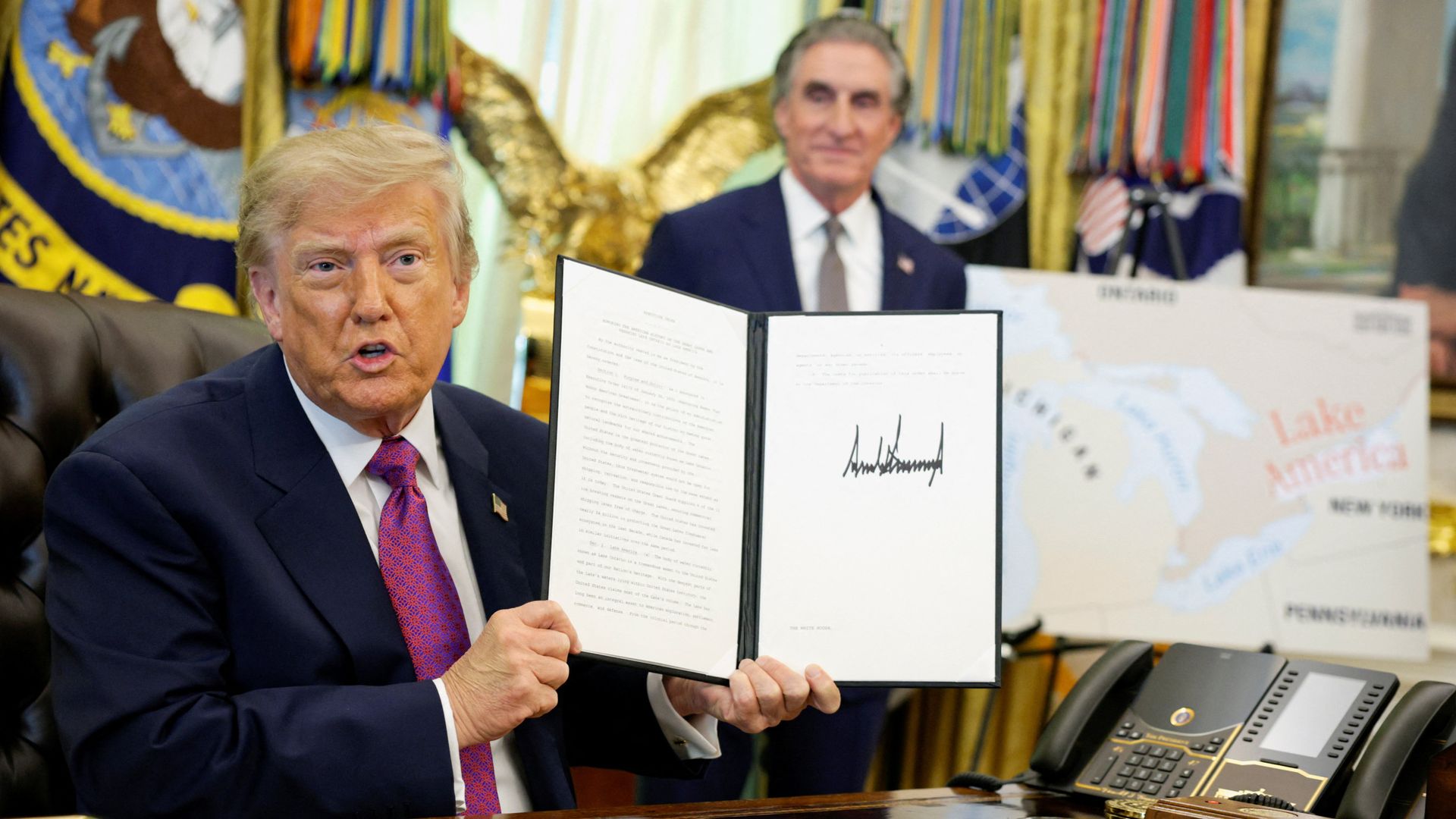
You can't just draw a new name over a major body of water and expect the world to go along with it, right? Think again. Donald Trump signed an executive order directing the federal government to officially refer to Lake Ontario as Lake America within the United States. This isn't just a quirky bureaucratic update or a random exercise in semantics. It's a calculated move deployed right in the middle of a brutal, escalating trade war with Canada.
When trade talks between Washington and Ottawa completely collapsed, the Trump administration slapped a staggering 50 percent tariff on roughly $20 billion worth of Canadian imports. Retaliation followed instantly from Canadian Prime Minister Mark Carney, who rolled out massive 25 to 50 percent tariffs on American goods. Renaming the lake functions as a psychological counter-punch, turning cartography into a weapon.
How Tech Giants Caved to the White House
Federal databases changed fast because the U.S. Geographic Names Information System (GNIS) updated its logs. But real-world utility requires digital mapping apps to play along. That is exactly what happened when Google Maps and Apple Maps updated their applications to show "Lake America" for users inside the United States.
Interior Secretary Doug Burgum didn't hide the strategy, noting that direct lobbying from the president pushed tech companies to adopt the new nomenclature. Trump quickly jumped on social media to declare the change "complete, ratified, and binding."
Users in Canada, however, see a completely different reality. Google and Apple configured their apps so that anyone north of the border still views the traditional Lake Ontario name. International users see both names awkwardly paired together. It's a digital split-screen reality that shows how fragile geographic standards have become when corporate tech policy meets executive pressure.
The Pushback from Canada
Canada isn't taking this sitting down. Ontario Premier Doug Ford responded by erecting a massive sign on the shore that explicitly reads "Lake Ontario. Now and Always" in both English and French. Ford dismissed the presidential decree as political theater, while Prime Minister Mark Carney pointed out that the name Ontario comes from the Indigenous Wendat language, meaning "beautiful lake" or "big lake," dating back centuries before either nation existed.
Meanwhile, smaller competitors like MapQuest seized a golden marketing opportunity. Refusing to bend to the White House's request, MapQuest posted a defiant screenshot of the traditional name with the caption "We're not changing it." That act of defiance sent the app straight to the top of the Apple App Store as consumers hungry for corporate independence rushed to download it.
Who Actually Controls the Map
Geographic naming is rarely just about navigation. It involves a complex chain of local input, federal committees, and international boundaries. Lake Ontario is governed by the BoundaryWaters Treaty, meaning the United States holds zero legal jurisdiction over Canadian territory or international hydrographic standards.
You can force US-based applications to swap labels for domestic users, but you cannot rewrite cross-border reality. When political ego collides with hydrography, maps stop being objective tools and turn into battlegrounds.
Check out this Lake America executive order overview to see the official announcement unfold.
http://googleusercontent.com/youtube_content/1