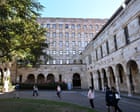
Imagine sitting in your office when twenty people wearing hoods and masks suddenly breach your door. They surround you. They block the exits. For ninety minutes, you don't know if you're dealing with an aggressive political protest or a violent assault. You don't know if you'll walk out alive. This isn't a scene from a political thriller. It's exactly what happened to Professor Steven Prawer inside his physics office at the University of Melbourne. His recent testimony before the Australian antisemitism royal commission has completely shattered the comfortable narrative that university campuses are safe spaces for intellectual debate.
The public inquiry into campus safety exposes a deep systemic failure. It shows how higher education administrators have completely lost control of their institutions. For months, university leaders hid behind vague statements about free speech. They pretended that the aggressive tactics of activists were just passionate expressions of political dissent. Prawer's testimony blew that excuse out of the water. It forced the public to confront the real, human cost of institutional cowardice.
When a distinguished professor of physics has to hire a private investigator just to find out who occupied his workspace, something is broken. The system failed. The administrators looked the other way. This inquiry is exposing the ugly truth about how Australian universities handle targeted harassment.
The Terror Inside the Physics Department
Professor Steven Prawer isn't just an academic. He's a self-described Zionist who wears a kippah and serves as the academic lead for a joint PhD program with the Hebrew University of Jerusalem. That role made him a specific target. On October 9, 2024, a crowd of masked activists decided that his office was the perfect place to make a political statement.
They stayed for an hour and a half. Prawer explained to the antisemitism royal commission that the timing of the incident made it terrifying. It occurred almost exactly one year after the October 7 atrocities in Israel. Tensions were incredibly high. Fear was entirely justified. Prawer testified that he genuinely didn't know if he was experiencing a standard student sit-in or a coordinated terrorist attack.
Think about that for a second. An academic in a major Australian city, sitting in a building funded by taxpayers, feared for his life because masked individuals forced their way into his private workspace. The activists claimed they were merely protesting the university's research partnerships. They tried to frame their actions as a noble stand against global injustice. Prawer called their arguments ridiculous. He pointed out that there's a massive difference between twenty students shouting slogans on a public lawn and twenty masked individuals cornering a single person inside a small room. The entire equation changes when you're trapped.
The Academic Board That Chose Appeasement
The initial institutional response looked promising. Former Vice-Chancellor Duncan Maskell stated he was shocked and appalled by the incident. An internal investigation led to a clear recommendation. Two of the student activists faced expulsion. Another two faced suspension. It seemed like the university was finally drawing a line in the sand. It looked like they were sending a message that intimidation has no place in higher education.
Then the internal politics of the university took over.
In June 2026, the academic board quietly overturned the expulsions on appeal. The students walked away without the ultimate penalty. To make matters worse, around 150 university employees and affiliates signed a petition defending the activists. These staff members argued that occupying a professor's office was a legitimate form of political protest. They completely ignored the psychological impact on the victim. They prioritised the political desires of masked agitators over the physical safety of their own colleague.
Prawer told the commission that he still doesn't know the identities of the people who invaded his space. Because the university wouldn't protect him, he took matters into his own hands and hired a private investigator. He feared the protesters might have deeper, more dangerous connections. He wanted protection. He wanted to know who to look out for. His core question to the royal commission was simple and devastating. Where is the deterrence? If a student can mask up, trap a professor in his office, and escape expulsion, what stops them from doing it again?
A Systemic Crisis Beyond Melbourne
The rot isn't confined to a single university in Victoria. The antisemitism royal commission has heard a flood of worrying testimonies from institutions across the country. Just days ago, the inquiry heard evidence from a University of New South Wales academic who was subjected to Nazi salutes right inside a classroom. This isn't ancient history. This is happening right now in modern Australia.
Another student witness testified about a chilling experience during a European Holocaust study tour. Classmates openly claimed that Jewish people weren't the main victims of the Holocaust. Some even filmed mocking TikTok dances in the parking lots of the Auschwitz concentration camp. When the student returned to Australia and tried to attend campus events, she was aggressively cornered by individuals who talked about exiling or killing the entire population of Israel. They reminded her that they watched her every single week.
These stories paint a grim picture. Campuses have shifted from institutions of higher learning into environments where intimidation thrives. The traditional rules of civil discourse have been abandoned. Faculty members and students are being targeted based on their identity, their faith, and their research partnerships.
The Government Steps In With Financial Threats
The absolute failure of university administrators to maintain order has finally forced the federal government to intervene. Federal Education Minister Jason Clare announced a significant shift in legislative policy. The government intends to change the law to force universities to adopt formal definitions of both antisemitism and Islamophobia.
They aren't just passing symbolic rules. The government plans to give tertiary education regulators real teeth. If a university fails to implement clear complaint systems, robust safety plans, and proper disciplinary policies, the regulator will have the power to issue massive financial fines.
It turns out that appealing to the moral conscience of university vice-chancellors doesn't work. The only way to get their attention is to threaten their funding. When a university faces millions of dollars in fines for failing to protect its staff, the administration suddenly finds the courage to enforce its own code of conduct. Interim Vice-Chancellor Glyn Davis is scheduled to face the royal commission next. He will have to explain exactly how his institution plans to fix this broken culture.
How to Fix the Campus Safety Crisis
The current approach isn't working. Statements of regret from university spokespeople don't keep people safe. If universities want to restore their reputations and ensure the safety of their staff and students, they must abandon the policy of appeasement. Here are the immediate steps institutions must take.
First, enforce a strict ban on facial coverings during protests inside university buildings. Free speech does not require a mask. If you want to protest a university partnership, you must show your face. Masking up serves a single purpose. It intimidates targets and hides identity to avoid accountability. Anyone who refuses to uncover their face inside an academic building should face immediate suspension.
Second, establish an absolute boundary around private staff spaces. Courtyards and public lawns are appropriate venues for peaceful assembly. Private offices, research laboratories, and lecture theatres are not. The moment a protest breaches a private workspace, it ceases to be a peaceful assembly. It becomes trespassing and harassment. Universities must treat it as a serious breach of the student code of conduct, resulting in automatic expulsion.
Third, strip academic boards of their ability to overturn disciplinary actions related to violence or intimidation. The Prawer case proved that internal academic bodies are too compromised by political bias and peer pressure to handle serious disciplinary matters objectively. Disciplinary appeals involving harassment or safety breaches should be handled by independent, external arbitrators who aren't susceptible to campus petition drives.
Finally, hold university executives personally accountable for safety failures. If a professor is forced to hire a private investigator to protect themselves because the university hides behind privacy policies, the executive team has failed its legal duty of care. Work health and safety laws must be enforced against university administrators who allow hostile work environments to persist.
The era of treating universities like sovereign kingdoms exempt from standard community expectations must end. True social cohesion requires rules that apply equally to everyone, regardless of their political cause.